Wednesday, November 2, 2016

Sense and Avoid Technology Now Available on Eagle XF

droneblog
November 2, 2016


Nottingham, NH, November 1, 2016 – UAV-America, Inc., announced today the implementation of its advanced Sense and Avoid System (obstacle avoidance) for their Eagle XF quad platform. Partnering with AerialGuard, based in Tel Aviv and New York, the two companies have designed and deployed a robust navigation system using Nvidia Jetson TX1 embedded platform combined with vision, acoustic and laser sensors, to provide Eagle XF customers with a safe, integrated platform to conduct infrastructure inspection and other tasks.

The system is fully integrated into the Eagle airframe and will benefit current work flow by increasing productivity and efficiency of operations. Among the advanced capabilities are: user-configured guardian mode (user configured safety distance from object), distance to target read-out, emergency return to land (RTL) integrated with obstacle avoidance, precise altitude hold, first person view (FPV), and full autonomous mission navigation capable of maneuvering around obstacles and obstructions.

This highly sophisticated system will be available as an option on all Eagle platforms and will be phased in with front and backward compatibility. The complete system is expected to be ready for shipment by the end of the year.

About UAV-America, Inc.:
UAV-America, Inc. manufacturers the Eagle series of UAVs for commercial and industrial applications: Infrastructure inspection, mapping and surveying, law enforcement, and any use requiring a platform capable of long flight times, flexible payload options, ease of transporting, safety and reliability.

About AerialGuard:
Specializing in autonomous navigation for UAVs, AerialGuard’s patent pending technology is a combination of on-board sensors and processors for high level autonomy, integrated into a ground station for operator control and on the cloud for collective intelligence, maximizing system potential while increasing safety, reliability and survivability.

SOURCE: Press Release


Read more at:
http://droneblog.com/2016/11/02/sense-and-avoid-technology-now-available-on-eagle-xf/

Watch This Girl Crush A Drone With Her Wicked Golf Swing


huffingtonpost.com
Steven Hoffer
September 1, 2016


Might need a mulligan on this one.

Eight-year-old golfer Ruby Kavanagh obliterated a drone that was filming her when she recently teed off at the Magenta Shores Golf Course in New South Wales.

Footage shows the flying gadget go into a tailspin as the golf ball rolls away.


Kavanagh is not just any amateur golfer. The Daily Telegraph in Australia called her a “golfing prodigy” after she qualified for the U.S. Kids Golf World Championship for the second time.

“Whoopsie - sorry I killed ur drone uncle Alex 😬,” she said Tuesday on her Facebook page.

Indeed, earlier posts on the Facebook page suggest they had shared some good times with that drone.


As for the drone and its owner now, they each seemed a little crushed.


Read more at:
http://www.huffingtonpost.com/entry/drone-golf-girl_us_57c831b7e4b0a22de09438d3?utm_hp_ref=drones


Rwanda Is Using Drones To Deliver Blood Donations To Remote Health Centers


Quartz Africa
Cassie Werber
October 14, 2016


ZIPLINE: You texted?


The world’s first commercial drone delivery service is in Rwanda, and it’s delivering blood.

The service is operated by Zipline, a US robotics and drone company. The drones drop blood parcels on parachutes outside remote health centers. Rwanda’s government pays Zipline for the deliveries, each of which costs about the same as the motorbike deliveries used previously,according to Keller Rinaudo, Zipline’s CEO. (The company declined to say how much that was, saying it would defer to the government to release the figure.)

Health workers can request a blood drop via text message, and it arrives around 30 minutes later. That makes a big difference in a country where short road trips can take hours. Blood loss after birth is one of the reasons maternal mortality is much higher in poor countries than rich ones; it’s the leading cause of death in Rwanda for pregnant women. And blood has to be stored carefully and matched to the recipient.

This is a video of the first blood delivery, from Zipline:


For now, Zipline will make between 50 and 150 deliveries per day to 21 clinics in the western half of the country. UPS, the US delivery and logistics giant, helped ship all of Zipline’s equipment to Rwanda. The UPS Foundation, the company’s charitable branch, earlier this year invested $1.1 million in a project to investigate how such drone delivery could be expanded to other medicines, and other countries.

And while for now the Rwanda service will just deliver blood, there are plans to expand into other medical areas, such as vaccines. Gavi, a public-private partnership which promotes vaccination, is partnering with UPS and Zipline on the research.

But while drones are being hailed as a solution to many problems across Africa, ranging from HIV testing to elephant conservation, they aren’t a simple business. Rwanda’s regulators are treating them favorably, but those in many countries don’t.

Kenya, worried about terror threats, banned commercial drones in January 2015. Ghana wants all drones registered and licensed, and is threatening hefty prison terms for anyone who doesn’t follow the guidelines. Nigeria has sought to cash inby making such licenses prohibitively expensive. South Africa, meanwhile, appears more lenient, though perhaps not so commercially savvy as Rwanda: it allows anyone over 18 to fly a drone for fun, but using one for business purposes requires onerous paperwork.

This article originally appeared on Quartz. Sign up for the Quartz Africa Weekly Brief — the most important and interesting news from across the continent, in your inbox.


Read more at:
http://www.huffingtonpost.com/entry/drone-delivery-service-launched-in-rwanda_us_5800f353e4b0162c043b7739?utm_hp_ref=drones

Hands on with Hover’s self-flying camera drone, which launches today


techcrunch.com
Fitz Tepper
Oct 13, 2016

A year or so ago a new type of drone hit the (preorder) market. It was the self-flying camera drone – a device that promised to combine camera and AI technology to create a drone that you could essentially throw in the air to follow you around and take photos and videos.


Some of these drones include Snap, Lily, Staaker and Hover. Most of these companies have raised tens of millions of dollars in either equity or preorders, but have taken a while to actually ship a product.

But today Hover is announcing that its first camera drone – named Passport – is going on sale today for $549 – a $50 discount on its eventual retail price of $599. We had a chance to try out Passport over the last week or so and were very impressed.


Compact Size


I moved to New York City a few months ago – it’s been great, except for the fact that I’ve essentially had to give up flying my drones. There’s no way I’m going to tempt fate (and the law) and fly a bulky Inspire or Phantom hundreds of feet in the air.

But Hover is different. The foldable drone weighs just half a pound, and is about the size of a book when in flying mode. When folded up, it’s basically the size of a VCR tape. I threw it in my girlfriend’s purse during an afternoon around the city, and after getting over the initial annoyance of having to carry her boyfriend’s drone she forgot about it. Compared to my Inspire’s bulky suitcase-sized case, Hover is a dream to carry around.


But of course Hover isn’t a full-featured drone like DJI’s Inspire or Phantom. While it does shoot 4K video and have a 13MP camera, it’s meant to be more of a close-up camera or tripod – not a true arial camera. The WiFi connection will drop when it gets about 60 feet away from you, and it’s just not meant to fly that high. The WiFi connection did drop once or twice on me, but this was before I even asked the company what the limit was – so it was definitely occurring when I was pushing past that 60 feet boundary. But when the connection drops the drone will just hover in place so you can walk closer and reconnect the WiFi.

But the benefit of not being a drone you can fly hundreds of feet in the air is you can fly it inside. Have you ever tried to power on an Inspire in your living room? I have, and I really really don’t recommend it. Hover on the other hand was perfect to fly inside my small New York apartment or outside on the sidewalk. The company added sonar sensors and a downwards facing camera that takes 100 pictures a second, both of which are designed to make sure the drone hovers exactly where it is supposed to. This stability is really what lets it be flown in close quarters without fear it’s going to accidentally stray into the wall.

So while one of DJI’s drones can be used to fly a few hundred feet in the air and take a video of your entire property, Hover is really meant to just fly a few feet away from you and take a photo or video of you or a group. Essentially like a flying selfie stick or personal photographer.


Camera

But all of this idealism about a new category of drone is useless if it doesn’t take good photographs.

Hover comes with stabilization (both electronic and through a one-directional physical gimbal) – which helps steady the footage. The company recommends shooting in 1080p and not 4K in windy situations, since that’s what their stabilization algorithm is optimized for.


While Hover’s camera isn’t good enough to take photos or videos you could use in a feature film, it’s good enough for the job. The camera lens is really small – about the size of an iPhone camera. And the footage it takes is about on par with what an iPhone 6S would take – which really isn’t bad for a $599 half-pound portable drone.


It also has a flash built in, which really helps with group or solo shots that are taken when the drone is just a few feet away from you. And the fact that Hover really has a flash really reiterates the fact that the drone was designed to be used for close-up photos and not true arial shots.

Essentially the camera will capture pictures that are more than good enough for Instagram or to send to your friends – but if you buy it hoping to capture stunning arial shots like you see in movies, you’re going to end up disappointed.

Artificial Intelligence & Manual Flying

Part of Hover being more flying camera than drone means it comes packed with some technology to help it take cool pictures. Once your drone is in the air you can switch to video mode which brings up a bunch of AI modes – follow, 360-Spin and Orbit.

Follow is self-explanatory – once the stream on your phone shows that you are in Hover’s field of view a yellow square will appear around your body. Double tap yourself and the square turns green, which means Hover has locked on. The drone will then follow you around when you walk (or slowly run). While it got confused when I would run and quickly change directions, the follow functionality was pretty well done.

Orbit is also really cool – after locking on Hover will stay about 10 feet away from you and orbit around you (even while you walk) the result is a cool video straight out of an action movie.

Hover can also be flown manually via on-screen joysticks in its mobile app. This was a great added benefit – some of these autonomous flying cameras brag that their AI is so good they don’t need to be (and can’t be) flown manually. This ends up being a pretty sucky experience, because at least part of the fun of owning a drone is being able to fly it yourself. And Hover’s small size meant I could fly it around inside my apartment, which is always fun.


Wrap Up

I was really impressed with Hover. I’ve played with drones in this new category of “flying camera” before, and most ended up being half-baked and disappointing. But Hover is really well done. If you’re looking for a second drone to supplement a beast like the Inspire or Phantom, or looking for a entry-level drone you can fool around with indoors or around friends, Hover could definitely be for you.


Read more at:
https://techcrunch.com/2016/10/13/hands-on-with-hovers-self-flying-camera-drone-which-launches-today/

Hillary Clinton considered drone attack on Julian Assange


rt.com
4 Oct, 2016


© Reuters


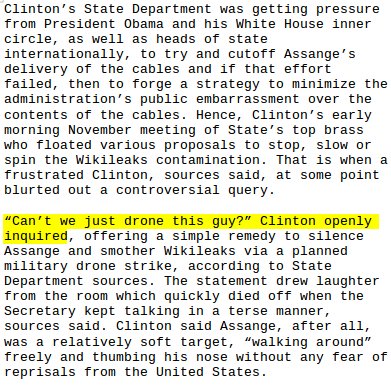
Democratic presidential candidate Hillary Clinton reportedly wanted to drone Wikileaks founder Julian Assange when she was secretary of state.


According to True Pundit, Clinton and the state department were under pressure to silence Assange and Wikileaks in the months before the whistleblowing site released a massive dump of 250,000 diplomatic cables from 1966 up to 2010, dubbed CableGate.

“Can’t we just drone this guy?” Clinton asked, according to unidentified state department sources.

Published by True Pundit on Sunday, Wikileaks posted a link to the story on their official Twitter account on Monday, along with a screenshot of the article.


Clinton and the state department held numerous meetings to discuss what could be done about Assange and his site which had already exposed damning military secrets about the war in Afghanistan and Iraq before the promised document dump was to come. The department was under pressure from both the White House and foreign governments to silence Wikileaks.

True Pundit reports the people in the room with Clinton on November 23, 2010 laughed at her comment, until it became clear that the then-secretary of state was serious. Clinton was reportedly fuming and referred to Assange as a “soft target.”


After Clinton’s drone suggestion, the state department considered offering a reward to anyone whose help secured the Australian journalist’s capture and extradition to the US. Unnamed sources reported a $10 million price was discussed at the meeting.

Following the meeting, Clinton aide Ann-Marie Slaughter emailed Clinton and aides Cheryl Mills, Huma Abedin and Jake Sullivan with the subject, "RE an SP memo on possible legal and nonlegal strategies re Wikileaks."

The email contained an attachment "SP Wikileaks doc final11.23.10.docx." which has not been found by federal investigators investigating Clinton’s use of a private email server. Wikileaks itself does not have this attachment.

Five days after the meeting, Wikileaks began releasing the CableGate files, on November 28, 2010.

Sources familiar with the meeting claim they were reminded of Clinton’s penchant for discussing droning enemies following the release of the FBI’s report on the Clinton email investigation, according to True Pundit.

The FBI’s notes on Clinton’s interview during the investigation referred to Clinton having “many discussions” about “nominating” droning individuals.

“Clinton could not recall a specific process for nominating a target for a drone strike and recalled much debate pertaining to the concurrence process. Clinton knew there was a role for DOD, State and the CIA but could not provide specifics as to what it was. Due to a disagreement between these agencies, Clinton recalled having many discussions related to nominating an individual for a drone strike,” the report reads.

Assange was set to make a big announcement at the Ecuadorian embassy in London on Tuesday where he has been trapped for five years, but cancelled in light of security concerns.

The teased leak, dubbed an “October Surprise” is thought to be damaging for Clinton before the presidential elections in November.

The announcement will now be made at Wikileaks’ 10-year anniversary celebration in Berlin on Tuesday. Assange will address the event via video leak.


InterDrone: Tackling sense-and-avoid technology in drones


InterDrone, The International Drone Conference and Exposition

September 6-8, 2017, Rio, Las Vegas


Christina Cardoza
Sep 9, 2016

Some day, businesses and operators hope that drones will be able to become fully autonomous and fly beyond line of sight. But in order for the FAA to feel safe, there needs to be a system in place that allows them to operate safely and efficiently without hitting anything.


The future of sense-and-avoid technology is being discussed at InterDrone this week. Tom Driscoll, founder and CTO of the radar technology company Echodyne; Alexander Harmsen, CEO and cofounder of computer vision company Iris Automation; Craig Marcinkowski director of strategy and business development for R&D company Gryphon Sensors; and Andrew Thurling, director of product safety and mission assurance for drone company AeroVironment, spoke on a panel discussing how we can advance this technology, what sort of software and hardware we will need, and how all of this will be integrated on the drone.

Right now technology like radar and computer vision are giving drones the ability to intelligently see and detect objects, but those technologies have their disadvantages.

According to Driscoll, while computer vision is great, it has trouble with range and operating in certain environments. But Harmsen argued that vision is a very cheap and powerful solution, and we need to be able to provide a vision system that is similar to what we have been using so that it is commonplace. Harmsen believes that radar is a new paradigm, and would take longer and be harder to adopt.

Thurling believes it will depend on the application, vehicle, and how the drones are operated. If you fly fast, the drone is going to have to look out far in front of it, but will only have to look at a small piece of the sky. If the drone is slow, it will have to be able to look behind it, so it depends on the flight characteristics of the drone, he explained.

What the panelists did agree on was that LIDAR would not be a good fit in sense-and-avoid technology. According to Driscoll, LIDAR’s range is a problem, and it doesn’t fix issues other sensors and technology don’t already fix.

Harmsen added that it is expensive, provides low resolution, and it is just too heavy to implement.

At the end of the day, Driscoll says in order to solve sense and avoidance, we need experts to step forward and help bring all this technology together. Harmsen believes it needs to be a software approach. Marcinkowski says sensor technology fused together will give us our best option. And Thurling wants to see a layered approach to this technology.


Read more at:
http://www.interdrone.com/news/interdrone-tackling-sense-and-avoid-technology-in-drones

U.S. Navy's first drone squadron stands up

Unmanned Patrol Squadron 19, comprised of MQ-4C Triton drones, stood up during Friday ceremony.


upi.com
Geoff Ziezulewicz
Oct. 31, 2016


The U.S. Navy's first drone squadron was stood up Friday at Naval Air Station Jacksonville, Fla. U.S. Navy photo


JACKSONVILLE, Fla., Oct. 31 (UPI) -- The U.S. Navy's first drone squadron was stood up Friday at Naval Air Station Jacksonville, Fla.

The new unit will be known as Unmanned Patrol Squadron 19 and is comprised of Northrop Grumman-built MQ-4C Triton drones.

The squadron will be co-located with manned P-8A Poseidon squadrons and will fall under Patrol and Reconnaissance Wing 11, the U.S. Naval Institute reported last week.

Its first deployment to U.S. 7th Fleet is slated for 2018, the institute reported.

While the squadron does not yet have any air vehicles, they are slated to arrive late next year.

Until then, squadron members are rotating through Naval Air Station Patuxent River in Maryland to train with the test pilots who are stationed there.

A Triton trainer will arrive in Jacksonville in January for training.

The new squadron's crews will also collaborate with P-8 pilots to develop tactics, techniques and procedures, the naval institute reports.

Unmanned Patrol Squadron 19 commanding officer, Cmdr. Benjamin Stinespring, called the standing up of the squadron "historic," WOKV reported.

"(Unmanned aircraft) is the way of the future and the Triton is the epitome of that," Stinespring was quoted as saying.


Read more at:

http://www.upi.com/Business_News/Security-Industry/2016/10/31/US-Navys-first-drone-squadron-stands-up/9341477923929/