Showing posts with label 3D print. Show all posts

Friday, February 17, 2017

Gizmowl Modular Open Source Drone Brand Seeks Support From UAV Makers and 3d Printing Community

suasnews.com
By Press
17 February 2017



A new modular open source drone, UAV and AI brand, Gizmowl, based on the white owl theme is seeking support from makers and 3d printers.

In drones and artificial intelligence technology development, a new and potentially popular brand has arrived on scene.

It’s called the BSM Gizmowl and it hopes to carve out a Khan like empire in the technology world.

“The Gizmowl brand is the result of centuries in software development, inventions branding at its highest level, animation and alternative finance” says Jesse Gilbert, founder of the company.


Gizmowl aims to be basically the ultimate future brand of drones for the non-quad-copter models.

It taps into the owl theme and folklore from a variety of cultures and epochs, creating and axiomatic brand that can hopefully accommodate a diverse variety of contributors.

“We bring Fortune 500 branding to the party. There may be no better name than the Gizmowl…The branding is something we do better than anyone else. Although our knowledge of the specific technology we will use is admittedly limited at this time, concept is king and what is better than the Genghis Khan white owl drone? The brand is designed to be a strong seller in the entire Middle Eastregion of the once Mongol empire.”

The company vision is to create an umbrella brand that provides opportunity to a number of individuals in the 3D makers and 3D printing community.

Gizmowl aims for top level functionality and would like to have designs and concepts that are modular and at least partially open source.

“The vision is rapid prototyping of the best owl drone with the most competitive features, even for military and aerospace. In addition, models for the civilian / consumer market will include a pet home white owl that can fetch stuff for the owner at pick-up windows at participating stores…or even from a neighbor’s house.”

The future of artificial intelligence and drones is uncharted territory that has some trepid, and perhaps rightfully so.

The Gizmowl brand and theme aims to open up the design and concept a bit and integrate feedback from participants every step of the way with the goal to eventually produce the top of the line artificial intelligence owl drone, that talks.

As of now the company is looking for support and collaborators who like the idea, particularly in the makers and 3d printing community.

“If we can provide means to create a cottage industry through localized 3d printing and distribution centers, then we will have the competitive advantage for speed and mobility needed to outmarket other brands and carve out a nice empire for all involved.”

One of the goals is actually to get a piece of the defense budget and portion some of it out to the makers community, possibly in the Bay Area or in regions of the U.S. that are amenable to building technology that can be used for defense.

“This is not a completely politically correct product but at the same time it is not fascist. There are real defense needs to be met as well as concerns for public oversight of drone programs. If our company can provide solutions in a way that is more effective dollar for dollar, then it is a good business that benefits the entire country. Our brand stands for something. If we put together the most desirable drone outside of military funded projects, then we have some real clout.”

The future of the maker community and 3D printing is exciting but also has it’s dark aspects.

Brainstorm Magic aims to be a visionary leader in this realm and provide solutions that people can live with…That maybe even make life better.

“Really anything is on the table. Best case scenario the military models are not needed for warfare and the company evolves into an aerospace and transport company, with modular designs for commercial and consumer flight vehicles. I believe in the 3d maker community and that it is the best possible solution to the economic woes of the United States in terms of manufacturing. This is partially because distribution centers of parts can be localized, the parts can be extremely light weight, and vehicles can be assembled on the spot.

Also, as nuclear battery technology advances, a lot of the work will be in the noble art of marketing, turning the dreaded word of nuclear into something that is associated with cost efficient energy, even leisurely pursuits in the aviation sector.”

Jesse invites makers and 3d printing enthusiasts to weigh in on the concept at http://www.gizmowl.com


Read more:
https://www.suasnews.com/2017/02/gizmowl-modular-open-source-drone-uav-brand-seeks-support-makers-3d-printing-community/

FREE 3D Printed Micro Quad design


suasnews.com
By Kirk Greninger
17 February 2017


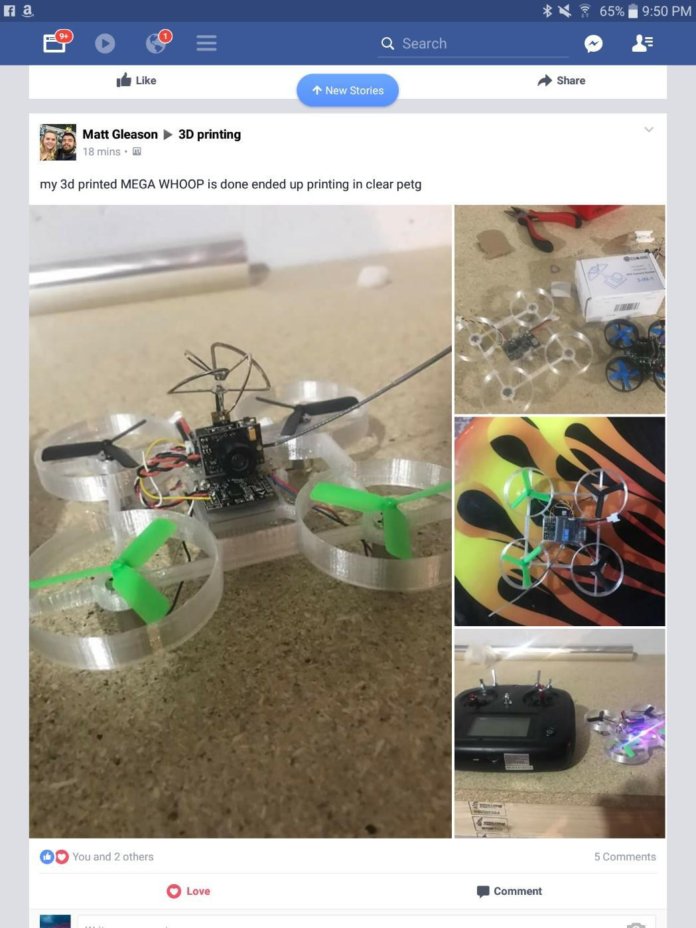
Yesterday while scrolling through my Facebook feed I ran across this little gem of a post by Matt Gleason featuring a 3d printed micro quad, Mega Whoop, while there are sure to be others out there this is the first I’ve seen posted publicly in the 3d printed groups also now offered on thingiverse the location where most free 3d print designs are exchanged. I contacted Matt and he gave me a little background on his experience and how this project came together.

Do you work in 3d printing or is it a hobby?


Matt: Just a hobby, I print a lot for household reasons, drones or building other printers
(laugh)

Matt: I designed and built this one


What lead you to design a 3d printed mini Quad? You’ve built your own printers from scratch?

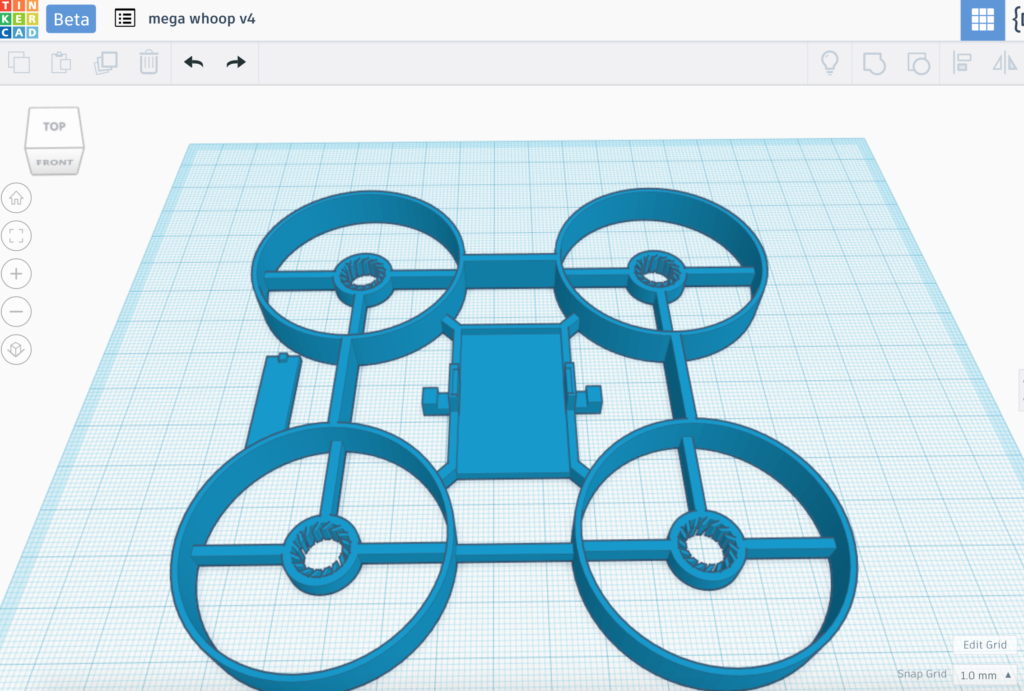
Matt: I bought a eachine 105 bat and broke it after one day and designed a new frame for it and decided I wanted something more indoor friendly and really like the tinywhoop but wanted something that would be able to handle outside also that’s when I decided to build an oversized tinywhoop I came up with a very interesting motor mount design also seeing as it’s hard to get the holes sized perfectly from 3D printing I went with a flexible pressure fit that it pretty unique!

Matt: And yes that printer I designed most of the parts some were taken from other designs like the corners and so on but I designed the important parts.

What application did you use to design the mini quad?


Matt: Thinkercad, it’s my go to design program

I see you are also in the sphere builders group, do you have a general interest in robotics?

Matt: I’ve always wanted to get into robotics but I’m not much of a programmer so that’s always stopped me 3D printing was definitely a good first step especially with building my own printer. I went into it knowing nothing about programming and had to learn simple Arduino coding to make it all work

So do you think you’ve become proficient with marlin and g code fairly fast, or has it been a slow Process?

Matt: Marlin was difficult for me to understand at first but after 3 days of messing with it I was able to flash my board and get everything working pretty well. I think my biggest problem was getting my e steps correct. As for gcode I don’t edit it much after what simplify 3D outputs no need really

Will you be selling the STL or offering it for free?

Matt: I’ll be putting it up for free just want to make sure the motor mounts I designed don’t fail over time also need to design caps for the bottom of the motors.

Mega Whoop brushed FPV

“ Summary:

I designed this mega whoop to be an indoor friendly large sized whoop! The motor mounts are force fit and hold very tight, I had to spin motors in with pliers. The camera mount I just hot glued to the top posts and used a small amount of hot glue to hold the camera in place since I wanted it all removable. battery is held in place with a rubber band which there are mounts for.”

Moving forward it will be interesting to see this technology adapted to production in novel ways like this to produce items once only attainable in a lab or through large scale manufacturing, I did mention to Matt that it’s possible to commercialize STL files in bundles with electronics kits and it’s likely we will see this in the future in both the commercial and hobby sectors of the drone industry.


Read more:


Monday, January 2, 2017

US Army Researchers Demonstrate 3-D Printed Drones


uasvision.com
January 1, 2017


US soldiers witnessed the innovation of Army researchers recently during flight testing of 3-D printed unmanned aircraft systems that were created on-demand for specific missions.

The U.S. Army Training and Doctrine Command invited engineers from the Army Research Laboratory to Fort Benning, Georgia Dec. 1-3, to showcase new technology at the Army Expeditionary Warrior Experiments, or AEWE.

“We’ve created a process for converting Soldier mission needs into a 3-D printed On-Demand Small Unmanned Aircraft System, or ODSUAS, as we’ve been calling it,” said Eric Spero, team leader and project manager.

With this concept, once a patrol requires UAV support, Soldiers input all their requirements into mission planning software. The system then knows the optimal configuration for the aerial vehicle and it’s printed and delivered within 24-hours.

“We thought they’re not going to think that’s fast enough, but, actually it was the opposite,” Spero said. “The timeline of 24 hours to receive a mission-custom UAS fits right in line with the way they plan and execute their missions.”

Researchers said they felt the combination of 3-D printing and UAVs was a natural technology solution.

“Drones or quadcopters are really getting big right now, I mean in particular just the commercial and hobby markets have shown what can be done with a small amount of money,” said John Gerdes, an engineer on the project. “Additive manufacturing or 3-D printing has become huge and everybody knows all the great things that can be done with 3-D printers. So we figured let’s assemble these two new technologies and provide a solution to Soldiers that need something right now and don’t want to wait for it.”

The team spent many hours flight testing and verifying the designs and to make sure everything was going to work the way they expected.

“It was good that we didn’t have any mistakes on game day,” said fellow engineer Nathan Beals. “The day before we did some test flights and worked out some kinks. I think we had the quad up to 55 miles per hour.”

Spero said based on feedback from Army leaders, his team hopes to work on low noise, long standoff distance, heavier payload capacity and better agility.

I’m very optimistic that most of those are achievable. I think the hardest one that’s going to be achievable is the heavy payload.

Soldiers at AEWE also became fascinated with 3-D printing technologies, Spero said.

“Before we even started the briefing, we set up the 3-D printer in the conference room and started a print job,” Spero said.

The researchers printed a Picatinny Rail, which is a bracket used to mount accessories on a small arms weapon, such as an M4 carbine. In about two and a half hours, they had a rail that fit the Soldiers’ weapons perfectly.

They asked the group what other kinds of 3-D printed items they could use. In a matter of hours, the team presented a variety of functional printed parts that impressed the Soldiers.

This isn’t just about UASs,” Spero said. “It’s about forward-deployed, 3-D printing to help the Soldier.

The Army engineers continue to collaborate with partners at the Georgia Tech’s Aerospace Systems Design Lab as they continue to refine technologies for future Soldiers.

Source: ECN


Read more at:
http://www.uasvision.com/2017/01/01/us-army-researchers-demonstrate-3-d-printed-drones/#more-47563