Showing posts with label China. Show all posts

Saturday, February 18, 2017

Power Company Sends Fire-Spewing Drone to Burn Trash Off High-Voltage Wires

gizmodo.com
By Matt Novak

February 17, 2017
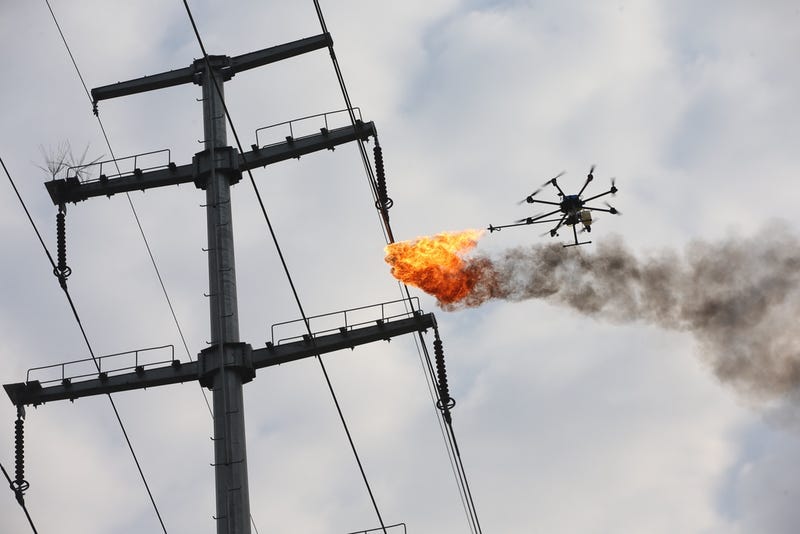


Electric company maintenance workers in Xiangyang, China used a fire-shooting drone to burn garbage from electrical wires (Photo by Wang Hu/VCG)


What happens when your power lines get all kinds of trash hanging from them and it’s not safe to send up a human? In Xiangyang, China, you send in the drones. Specifically, the drones that shoot fire.


Just in case you were worried that the robot uprising was delayed, fear no more. It appears to be right on time, as these fire-spewing drones are sent to burn off trash that gets stuck on high-voltage wires.

The drones are being used by an electric power maintenance company in China to get rid of plastic bags and other debris that get caught in places that are hard to reach with a human in a cherrypicker.

Now, before you get all worried about drones like these being used to kill humans, just remember that drones are already being used to kill humans practically every day. Targeted US military strikes against suspected terrorists occur on a regular basis, and terrorists themselves have gotten into the drone game.

Some reports indicate that terrorist groups such as ISIS are trying to figure out how to deliver chemical weapons via drone. Flame-shooting drones would be tame by comparison.

So when you see headlines like “It’s only a matter of time before a drone kills someone,” it’s important to remember that that time has already come. Let’s not sugarcoat it. We haven’t heard reports about anyone burned to death by this particular style of drone, but that doesn’t mean it hasn’t happened yet.
Electric company maintenance workers in Xiangyang, China used a fire-shooting drone to burn garbage from electrical wires (Photo by Wang Hu/VCG)

Don’t live in fear about the future. The future is already here.


Read more:
http://gizmodo.com/power-company-sends-fire-spewing-drone-to-burn-trash-of-1792482517

Monday, February 6, 2017

China Offers Air-Ground Missiles for Drones

uasvision.com
February 6, 2017


China can now offer users of its combat drones a new missile designed for anti-terrorism operations and low-intensity conflicts. The new, short-range AR-2 is perfect for mounting on drones in anti-terrorism uses, officials said.


The China Academy of Aerospace Aerodynamics, the country’s largest military drone exporter by number of products sold overseas, said it recently conducted live-fire tests on the AR-2 short-range air-to-surface missile in northwestern China.


AR-2 fired from CH-4

A CH-4 reconnaissance/combat drone was used in the tests, though the missile can also be mounted on other CH drones, officials said. The academy’s CH-series drones have been sold to military users in over 10 countries.


AR-2 Missile

The missile also can be carried by Chinese attack helicopters and other unmanned aircraft after minor technical modifications, they said.

With a weight of about 20 kilograms and a 5 kg warhead, an AR-2 has a maximum range of 8 kilometers and a top speed of 735 kilometers per hour. It is effective against personnel, armoured cars, houses or bunkers, its designers said.

Zeng Like, project manager for the AR-2, said that the academy hopes to win market share from the United States’ AGM-114 Hellfire, widely used in the 1990s and 2000s. At least 29 nations, including Australia, France and South Korea, deploy the Hellfire, according to Jane’s Weapon Systems.


“There are a lot of counterterrorism operations and low-intensity conflicts in the world that create a huge demand for low-cost, high-efficiency weapons to hit cars or light-duty, armored vehicles,” he said. “We believe that most ground targets designated for drones are soft targets or lightly armored vehicles, so using a heavier missile such as the AGM-114 Hellfire for such operations is a waste.”

Smaller, cheaper missiles like the AR-2 are powerful enough to handle those targets, and their lighter weight enables a drone to carry more missiles, Zeng said.

The AR-2′s biggest competitors are the US’ AGM-176 Griffin, currently the best-selling lightweight precision-strike weapon, France’s Lightweight Multirole Missile and Israel’s Whip Shot missile, he said.

But, Zeng said, “the AR-2 features strong capabilities and a lower price, so we are positive it will have good market prospects”.

Many of the academy’s clients now use the bigger, heavier AR-1 missile with CH drones, he said.


AR-2 and AR-1Missiles

In another development, the academy said trainees from one of its foreign clients performed a test in which four CH drones were networked to perform as a fleet.

Ground controllers from the unnamed foreign nation who were trained at the academy guided four CH-4B drones via satellite to work together in a patrol.

Huang Wei, a senior researcher who oversaw the test, said the networking of multiple drones is useful for joint operations in combat. Huang said only China and the US are capable of conducting joint operations using multiple drones.

Source: China Daily


Read more:
http://www.uasvision.com/2017/02/06/china-offers-air-ground-missiles-for-drones/

Sunday, January 22, 2017

China’s Sharp Sword Wins Technology Prize

uasvision.com
January 20, 2017


The Sharp Sword UAV, China’s stealthy attack drone, just won second place in the National Science and Technology Advancement Prizes. Considering the secrecy surrounding stealth drones to come out of China—there are relatively few photos of the Sharp Sword available, particularly as opposed to, say, the J-20 fighter—the Sharp Sword’s victory is pretty noteworthy.

The drone, known as “Lijian” in Mandarin Chinese, is being paraded as a huge win for Chinese aviation technology.


Credit: Hongjian via China Defense Forum

The Sharp Sword is the first non-NATO stealthy unmanned combat aerial vehicle (UCAV). Built by Aviation Industry Corporation of China, with much of the work done by the Hongdu Aviation Industry Group, the Sharp Sword first flew in November 2013. Looking a bit like a mini-B-2 flying wing bomber, the UCAV has two internal bomb bays and a likely payload of about 4,400 pounds. Its engine is a non-afterburning WS-13 turbofan engine, with serpentine inlet to hide the engine from enemy radars (the first Sharp Sword does not use a stealthy nozzle due to its technology demonstrator status). It has a length of about 33 feet, and a wingspan of about 46 feet.


Sharp Sword UCAV on its first flight on November 21, 2013.

Reporting from the Chinese Internet suggests that a second, even stealthier Sharp Sword began flying last year (with a stealthy engine). If flight testing with the prototypes goes as well as the initial flight tests did with the first airframe, the Sharp Sword could enter service as early as 2019-2020.

Initially, it’s believed that the Sharp Sword will be used for reconnaissance in areas with dense air defense networks, as well as tailing foreign warships. As the Chinese develops a familiarity with the Sharp Sword, it could be used for combat operations as a “first through the door” weapon against highly defended, high-value targets, as well as an aerial tanker for other drones and carrier aircraft (akin to plans for the U.S. MQ-25). There is even the possibility of carrier version for China’s planned next generation of catapult equipped aircraft carriers.

Eventually, advances in distributed systems and artificial intelligence could help the Sharp Sword be a robotic wingman to manned aircraft in an unmanned/manned operational concept. It could even take on autonomous missions of its own.

Source: Popular Science


Read more at:

Wednesday, January 18, 2017

Has China Won The Drone War?

forbes.com
Benjamin Joffe ,
January 17, 2017


Chinese companies won the drone war (Photo: Benjamin Joffe)

Most afternoons, from outside our windows that look out over Shenzhen's giant electronics market in Huaqiangbei, we can hear a familiar high-pitched hiss.

The source is a large plane-like drone, circling endlessly just above us.

Taking down to the streets below one can find everything from imagery quadcopters to toy microdrones. Drone technology is big business in this southern metropolis – China’s undisputed tech hub. And companies such as DJI are at the cutting edge.

But far away from Shenzhen, the picture is not as rosy for established players in this highly-competitive industry. Heavyweights like 3DR and Parrot have been forced into major restructuring of their businesses, GoPro recalled its first drones, and Lily Camera just filed for bankruptcy.


Are Chinese companies winning a drone war?

CES 2017: Chinese Drones Everywhere

Judging by what I saw at the drones area of the CES Consumer Electronic Show in Las Vegas earlier this month, it seemed like China's victory was total.
Recommended by Forbes


Xiaomi was displaying a drone with a 4k camera from for a mere $433; in China, Tencent launched a foldable 4k drone for $299.


Xiaomi displays its 4k drone at CES for $433 (Photo: Benjamin Joffe)

Then I had doubts when seeing the booths of Furrion, which showed a giant robot alongside its products, and Contixo, whose booth was manned by Caucasians. But the former turned out to be a Hong Kong company, and the latter the U.S. distributor of a Shenzhen OEM.

Big business indeed, but could such innovative products had already turned into commodities?

Here are a few things to consider:

China Has Won The (First) Consumer Drone War

Technology that enable a remote-controlled stable flight, which impressed a few years back, is now widely available.

“For outdoor imagery it is impossible to compete because of the low technology barriers. Once you start hitting commoditization Chinese companies have a massive edge. Trying to get in DJI’s way is pretty much death,” says Jeffrey Tseng, Founder of the San Francisco-based startup Aevena, which develops indoor drones.

This is indeed what 3DR learned when it switched from its hobbyist niche to mass market.

According to Jenny Lee, General Partner at GGV Capital, a cross-border fund active in hardware (Lee herself is a former drone engineer), the consumer drone market is now going through a consolidation phase.

But is the drone market now in the hands of China's DJI, Yuneec, EHANG, Hover Camera and their likes?

Maybe not. Business use cases require specialized machines and software, and even the consumer market is evolving as software takes precedence. For instance, Juuk, a Silicon Valley-based startup that HAX (the hardware accelerator I help run) invested in, operates based on the conviction that “if you can’t beat them, join them,” by working with Chinese companies to build a drone that interacts and plays different games with you without a remote. Former staff from leading drone companies are also likely to play a key role in the next generation.

More Opportunities In the Commercial Drones Market

This is a consequence of the diversity and specificity of their requirements. Regulations are also crucial and vary with industries and location--sometimes giving an advantage to emerging markets. Beyond the often talked-about delivery drones, the first applications are in construction, agriculture and mining: they operate on private land, with people following safety procedures or equipped with hard hats. Farmland Keeper is a GGV investment which, for instance, does crop-dusting in China.

While the term “drone” today mostly evokes the quadcopter shape, Toivo Annus, the former head of engineering at Skype who turned into a very active drone investor, points out that there is a richer taxonomy: “Different end uses call for different shapes, forms and qualities. There’s blimps, rockets, fixed wing, hybrids. Some are as big as passenger planes, some fit in your hand, some target high or low altitude, short or long distance. The list goes on and is evolving."

The inspection of vertical, hard to access and linear infrastructure are also promising sectors. Things like cell towers, chimneys, oil rigs, roads, pipelines, and so on. Various startups have cropped up to focus on these applications and many believe that consumer and business sectors might converge soon.

Drones Are Like Phones 20 Years Ago

According to Annus, drones are today where phones were 20 years ago, or cars 100 years ago: "A little one-dimensional and frustrating, but already useful with big potential."

According to Michael Novikov, a drone investor with San Francisco-based Knowledge Investments, Western companies are likely to lead in drone "brains" and specialized payloads: “In particular, American, German, British, Israeli and Swiss companies, thanks to avionics, navigation, sensors, processors, onboard data processing and AI, and special purpose equipment.”

“Today, Chinese companies can only catch up. For example, DJI just purchased Hasselblad, a Swedish high-quality camera company,” he adds.

Tseng comments that technologies from the self-driving car stack and the AR side are likely to trickle down to drones.

An Ecosystem For Drones Is Forming

A complete drone ecosystem is forming, but might take years depending on the industry. It includes people flying the drones, regulators, insurers, manufacturers, software companies, and of course their end clients.

The question is, will Chinese companies be able to expand globally? Those who go beyond building hardware and take steps to engage with the ecosystem might. And some have already started.


Read more at:

Tuesday, January 17, 2017

If Drone Swarms Are the Future, China May Be Winning


Why use one drone when you can use one hundred?


popularmechanics.com

By David Hambling
Dec 23, 2016 


Although large Predator and Reaper drones are the face of modern militaries, drone swarms—dozens of fixed-wing drones flying in coordinated formation— could be the future of unmanned combat. And if these aerobatic flock of drones are in our future, then the Chinese believe they're firmly in the lead after releasing a video last month of the largest swarm of fixed-wing drones ever flown.

As you'd expect, a drone swarm's advantage relies on the age-old truism of strength in numbers. Where one missile can knock out a multi-million dollar F-35 (and one mechanical failure can ground it), a swarm can take on casualties and failures and just keep going. If a swarm is big enough, it can overwhelm defenders by attacking with more drones than they can handle.


CURRENTLY ONE MAN CAN CONTROL MULTIPLE DRONES IN THE SYSTEM. IN THE FUTURE, ONE MAN WILL BE ABLE TO CONTROL HUNDREDS AND THOUSANDS OF DRONES,"

In the U.S., the Navy's LOCUST wants to field a swarm of attack drones that would cost collectively less than a single missile, while DARPA works away on its swarming Gremlins and the Air Force's develops miniature drones that can overwhelm air defenses.

"You have maybe 100 or 1,000 surface-to-air missiles," Col. Travis Burdine, the Air Force's division chief for unmanned aircraft, told Flightglobal in April. "But we're going to hit you with 10,000 [small drones]."


CETC

The key to a swarm is that the entire group acts as a single unit, but they're not centrally controlled. Instead, each member of the swarm uses software for coordination that mimics how flocks of birds and schools of fish behave. Currently, military drones like the Reaper are flown individually by a remote pilot, but a single operator could command any number of drones in a swarm. The operator issues a general instruction such as "search this area," and the swarm automatically co-ordinates its individual members to get the job done.

For years, the U.S. appeared to have a clear lead when it came to swarming drones. Last year the Advanced Robotic Systems Engineering Laboratory (ARSENL), claimed a new world record by launching a swarm of 50 drones at Monterey, California, all controlled by the same operator. But at the 11th China International Aviation and Aerospace Exhibition last month, state-owned China Electronics Technology Group Corporation (CETC) claimed to have shattered that record with a swarm of 67 drones flying together.

"Our swarming drone technology is the top in the world," CETC's Zhang Dengzhou told reporters.


The CETC video (above) shows the drones taking off and maintaining formation, and claims they are capable of networking together in flight and collaborating to carry out intelligence, surveillance and reconnaissance missions. These are key capabilities of a true autonomous swarm which can act without human oversight. But who knows how well the software handles real-world situations.

The final GCI-filled section of the video hints at future ideas for drone swarms, like a "saturation attack" where drones locate an enemy missile launcher and destroy it in a major assault.

The Chinese get more drones in the air because rather than having sophisticated chain-driven launchers like ARSENL (top GIF), their drones take off with what are essentially giant rubber bands (at around 40 seconds in). The number of launchers and the time it takes to reload was one of the limits on the U.S. exercise. It's also one of the reasons why the record for multi-copter swarming drones, which take off vertically without launchers, is much higher – Intel staged a 500-drone lightshow earlier this year.


Although CETC says it's coordinated 67 drones, the video never shows more than 50 drones at a time.
CETC

The Chinese drones in the video have been identified as Skywalker X6s , made by the Skywalker Technology Co. based in Wuhan, China. Skywalker drones are popular among hobbyists as they can be bought in kit form for a few hundred dollars and fitted with custom electronics. ARSENL even used Skywalker X8 drones in their swarm. Skywalker drones are so popular because they're cheap, readily-available, and easy to customize. It's also why ISIS has adapted Skywalker drones to carry bombs.

The surprising thing is that Chinese swarming drones have come out of nowhere. So does this new announcement mean the Chinese are quietly edging ahead in swarm technology? China already makes portable kamikaze drones with explosive warheads, and effective swarming software would allow them to be deployed in large numbers, whether launched from the ground, sea, or air.

"Currently one man can control multiple drones in the system. In the future, one man will be able to control hundreds and thousands of drones," says Zhang.

Although militaries continue finding effective counters to small drones, some suggest that tactical swarms may rule the future battlefield. If that happens, then whoever has the best swarm wins, and China says they're in the lead. Although it's a hard claim to assess, it's a difficult one to ignore.

David Hambling is author of "Swarm Troopers: How small drones will conquer the world"


Read more at: