Showing posts with label sUAS. Show all posts

Monday, February 20, 2017

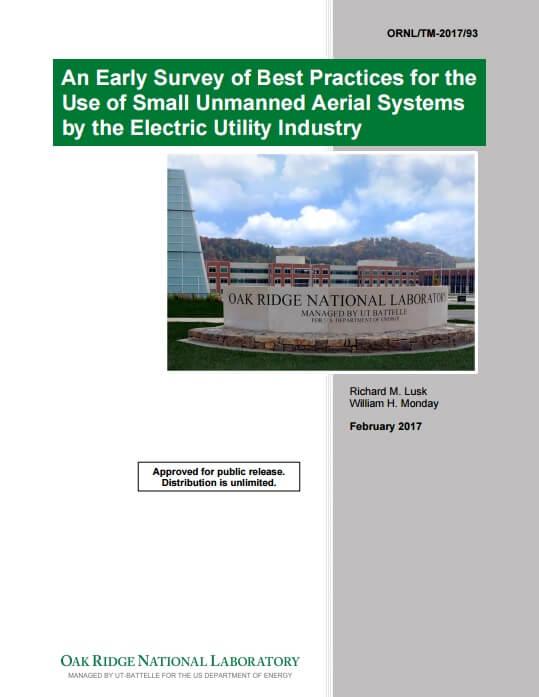
FREE Publication: Best practices for the use of sUAS by the Electric Utility Industry

suasnews.com
By Gary Mortimer
20 February 2017


A weighty and informative report from ORNL penned by Richard Lusk and William Monday. The report is crammed with information useful for any commercial UAS operator. It includes checklists as well. Always good to see other people’s thinking on that subject.

The introduction is bang on as well, top notch, if you are a serious drone pilot don’t continue with your day until you have downloaded this!

Unmanned aircraft have been around longer than anyone reading this preface. Previously the domain of military operations and some dedicated hobbyists, the technology has become commoditized.

Miniaturisation of computational components, mixed with ubiquitous GPS access and leveraged manufacturing economies of scale, has introduced relatively aerodynamically stable personal drones into everyday life.


The change that is upon us now is that the barrier for access to this technology is a few hundred US dollars. A person with no training or experience can purchase one of these machines and fly it into the National Air Space the same day.

The following analogy is one I frequently use when discussing this three-dimensional risk with people who have little experience with aviation, airspace, or UASs.

Let us say that someone goes into a big-box store and purchases a go-cart. Upon leaving the store, he starts the go-cart and immediately drives it across the parking lot; across the interstate, obeying no right of ways or traffic laws or signs; and across people’s property, at random.

People respond, “That’s crazy. No one would do that!” However, that is exactly what many, and perhaps most, new drone “drivers” do.


Read more:

Tuesday, January 31, 2017

Coast Guard Conducts small Unmanned Aircraft System Testing On Cutter Stratton

suasnews.com
By Press
30 January 2017


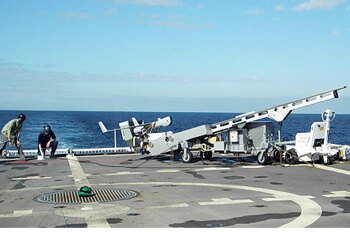
The Coast Guard completed system operational verification testing of a small unmanned aircraft system (sUAS) on Coast Guard Cutter Stratton, a national security cutter (NSC) based in Alameda, California, Jan. 2.

The Stratton crew and UAS program officials tested the power, communications, and launch and recovery systems that make up the sUAS to ensure that all parts functioned as needed and to identify areas requiring improvement. The full system consists of the aircraft, a ground control station, and a forward and an aft directional antenna, which contain the necessary fiber optic cables needed to communicate with the aircraft. Installation of the system components was completed Dec. 23; testing began a week later.

The testing prepared the Coast Guard for the sUAS deployment on Stratton planned for this winter, data from which will help the service assess how to make the most of sUAS capabilities on patrol while minimising risk. The initial deployment will use ScanEagle sUAS capability obtained through a June 2016 order on a pre-existing multiple-award contract executed by the Naval Air Systems Command. The Coast Guard will use the deployment data to refine the concept of operations and requirements for installing and integrating future systems across the NSC class. These requirements will inform a request for proposal for sUAS for NSC capability, planned for release by the end of fiscal year 2017. The contract award for the retrofit of Stratton and one additional NSC is targeted for fiscal year 2018.

The service is also looking into the possibility of integrating sUAS into other cutter operations. Lessons learned from the integration of sUAS capability on the NSCs will guide future procurement of systems on other cutter classes. “The upcoming deployment is going to inform the sUAS for NSC strategy, and the eventual sUAS for NSC solution is going to inform the Coast Guard’s long-term sUAS strategy,” said Jeff Bishop, UAS program manager.


The acquisition of sUAS for the NSCs is in the Analyze/Select phase, which involves establishing operational requirements, evaluating acquisition approaches and assessing the merits of each approach. The Coast Guard is pursuing the sUAS acquisition to provide persistent, tactical airborne intelligence, surveillance and reconnaissance to enhance the cutters’ effectiveness.


Read more at:

Tuesday, January 10, 2017

Free Online Course about New FAA Regulations from Embry-Riddle

suasnews.com
By Press
9 January 2017
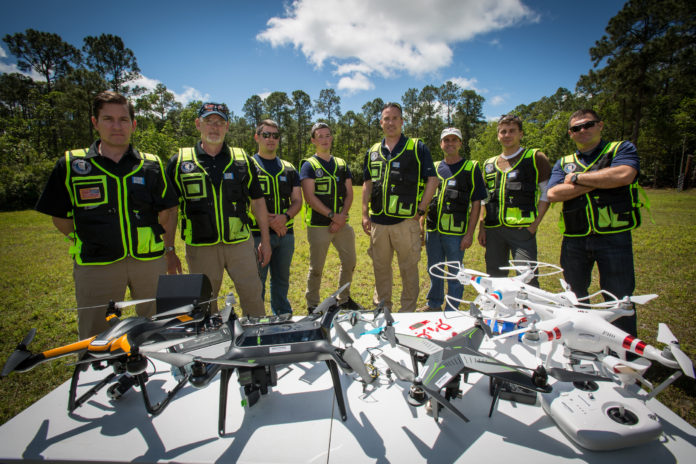

A team of faculty from the Worldwide campus tests UAV's, in partnership with Nevada Institute for Autonomous Systems, NIAS, at a property in New Smyrna Beach for a UAV user's guide, April 23, 2016.

DAYTONA BEACH, Fla. – If you received a small unmanned aircraft system (sUAS), or drone, as a gift this holiday season, or if you want to stay updated on the latest FAA regulations for these aircraft, Embry-Riddle Aeronautical University is providing a free, two-week online course–Small Unmanned Aircraft System (sUAS) – Key Concepts for New Users. Registration for the course is now open.

The Massive Open Online Course (MOOC) runs Feb. 6 to 19 and introduces novice sUAS users and seasoned aeronauts to numerous aspects of unmanned systems, as well as current and future applications. The MOOC also offers guidance on responsibly piloting aircraft in the National Airspace System (NAS).

This course is taught by a team of UAS experts, led by Dr. Scott Burgess, Associate Professor at Embry-Riddle Worldwide’s College of Aeronautics. Dr. Burgess has over 30 years of aviation expertise in both military and civilian aircraft, including helicopters and unmanned aircraft systems.

“This post-FAA Part 107 course will focus participants toward regulations, safety of flight and flight planning considerations,” said Burgess. “We have an outstanding team of faculty with private, commercial and government sector experts teaching on topics such as UAS integration, regulation, international operations, safety and systems. We will also harness the power of social media so participants can interface directly with each other and faculty.”


Students will learn the basic elements of safety, and airspace definitions and regulations so those individuals using the NAS understand and use best practices for reducing the risk of collisions between aircraft when operating a sUAS. This popular course, previously offered in 2016, has been updated to include the FAA’s new 2016 regulations (FAA Part 107) for sUAS operators.

For more information and to register go to Small Unmanned Aircraft System (sUAS) – Key Concepts for New Users. You may also download Embry-Riddle’s free sUAS Consumer Guide, designed to assists a wide variety of users, especially novices, to evaluate options for purchase, appropriate to their skill and experience levels, while introducing key metrics for future consumer sUAS comparison.


For additional information on this and other specialized industry training online courses, please contact Gary Burke, Worldwide Director of the Office of Professional Education, Embry Riddle Aeronautical University, 600 S. Clyde Morris Blvd., Daytona Beach, FL 32114. Email: training@erau.edu; Phone (386) 226-7232.

About UAS at Embry-Riddle
Embry-Riddle was one of the first schools in the nation to offer a degree in UAS and today has the nation’s largest UAS degree program. The University offers: a Bachelor of Science in Unmanned Aircraft Systems Science at the Daytona Beach, Florida and Prescott, Arizona Campuses; a Bachelor of Science in Unmanned Systems Applications through the Worldwide Campus; a Master of Science in Unmanned & Autonomous Systems Engineering at the Daytona Beach Campus; and a fully online Master of Science in Unmanned Systems through its Worldwide Campus. Embry-Riddle is also a co-founder of the ASSURE Coalition (Alliance for System Safety of UAS through Research Excellence), a Federal Aviation Administration Center of Excellence in Unmanned Aircraft Systems.


Read more at: